
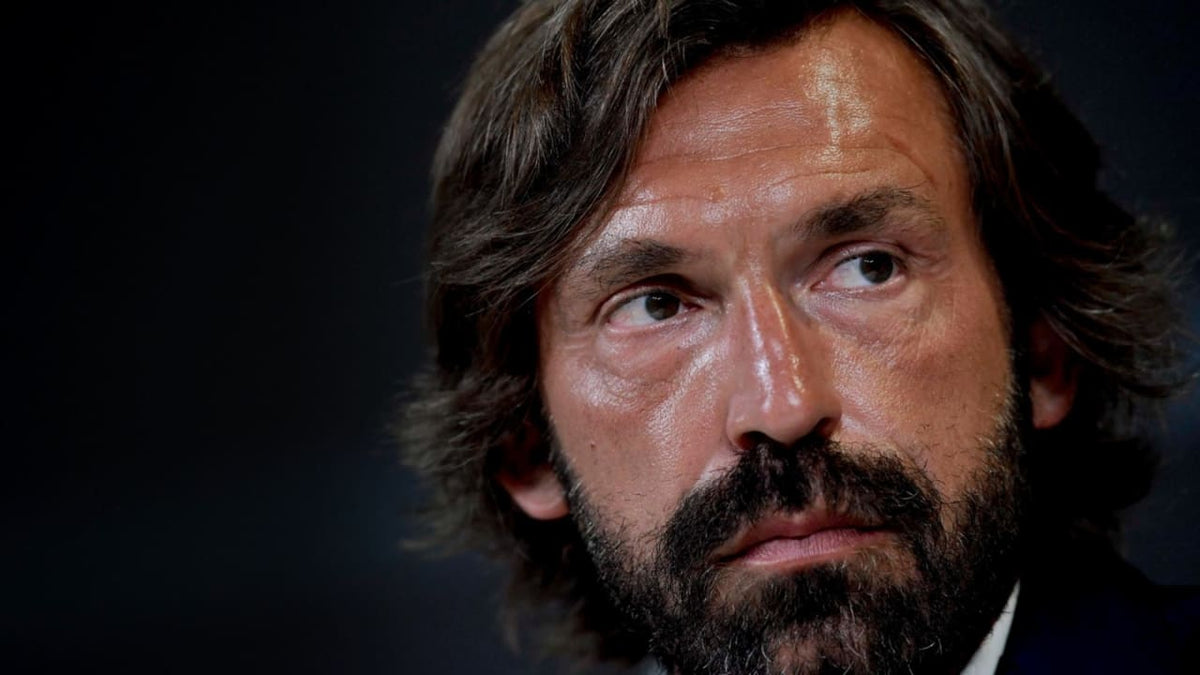
Andrea Pirlo: The Coolest Playmaker

He never ran faster than the game. He simply saw it sooner.
Dortmund, the 119th Minute
Dortmund, 4 July 2006. A World Cup semi-final, Italy against Germany, in a stadium built to intimidate visitors. Sixty five thousand people. The host nation had never lost a match in that stadium.
The match is goalless after 118 minutes. Everyone is tired. Everyone except one man, who has spent two hours looking as though he were waiting for a table at a restaurant he already knows will seat him.
A corner is half cleared. The ball comes to Andrea Pirlo on the edge of the area. A crowd of German shirts closes in. He shapes to shoot. He shifts the ball once, then again, the defenders swaying with him like grass in wind. Then, without lifting his eyes towards his teammate, he slides a pass into the one space nobody else in the stadium had noticed. Fabio Grosso takes it first time and curls it past Jens Lehmann.
Italy score again moments later. The German crowd falls silent. Five days on, in Berlin, Italy are champions of the world.
The goal belongs to Grosso. The moment belongs to Pirlo. It is the purest expression of what he was: a footballer who kept his own tempo, and who made the whole game wait for him.

A Boy from Flero
He was born on 19 May 1979 in Flero, a small town just outside Brescia, in the industrial north of Italy. It is a working town, not a postcard. The boy's business, from the start, was the ball.
He was quiet. Thin. Not especially quick. In a country that prized the fearsome mediano, the ball winner who lives on aggression, Pirlo offered something else entirely. He played as if he had read the match the night before.
Brescia gave him his Serie A debut at sixteen. Inter Milan signed him in 1998. The early years were not easy. Inter did not know where to put a playmaker who could not sprint past anyone and had no interest in trying. He was loaned out. He waited. He did not change who he was.
The Number 10 He Gave Away
The turning point came back home in Brescia, in 2001, and it came with a ponytail.
Roberto Baggio was in the side. Baggio, the Divine Ponytail, wore the number 10 and owned the space behind the strikers. There was no room for two artists in the same square of grass. So the coach, Carlo Mazzone, made a decision that would change the history of Italian football. He moved Pirlo back. Deeper. In front of the defence.
It should have been a demotion. Instead it was a revelation. From that position, Pirlo could see everything. The whole pitch opened in front of him like a map. He was no longer the man who made the final pass. He was the man who decided where the match would go, long before anyone else knew it was going there.
The Italians have a word for it: regista. The director. Not the actor on the stage. The man who arranges the stage itself.
There is a lesson in that. Pirlo did not fight for the number 10. He respected the greater player in front of him, accepted a quieter role, and turned it into his own form of genius. He found his legend by stepping back.

The Architect
Milan signed him in 2001. Carlo Ancelotti, another gentleman of the game, understood exactly what he had. He built a midfield around Pirlo with Gennaro Gattuso snarling at his side and Clarence Seedorf beside them. Gattuso did the running. Pirlo did the thinking. It is one of the great partnerships in football history, and one of the most honest. Each man knew precisely what he was, and what he was not.
In Milan they called him L'Architetto. The Architect. He did not tackle with anger. He positioned himself so the tackle was rarely needed. He did not shout. He gestured, barely, and the team moved.
What followed was a decade of the highest football. The Champions League in 2003, at Old Trafford, against Juventus. The Scudetto in 2004. The Champions League again in 2007, in Athens, against Liverpool. And between those two European nights, Istanbul in 2005, when Milan led by three goals at half time and lost on penalties. Pirlo later said that night nearly made him quit the game. He did not quit. He came back. Two years later he lifted the trophy against the same opponent.
The Art of Doing Less

Watch Pirlo closely and you notice how little he does. That is the secret.
Before the ball arrives, his head turns. Left. Right. Over the shoulder. He has already taken a photograph of the pitch. When the pass reaches him, his body is open, half turned, so the first touch sends the ball where it needs to go. There is no wasted movement. No flourish for the crowd. The ball does the travelling. He barely seems to move at all.
Then the pass. Often it is short, simple, almost dull, the kind that keeps a team breathing. And then, without warning, it is forty metres long, a diagonal dropped onto the boot of a winger who had not yet realised he was free. Opponents learned that pressing Pirlo was like chasing smoke. By the time they arrived, the ball had gone, and so had the danger.
He was never the fastest man on the pitch. He did not need to be. Speed of thought is the only speed that never fades.
There is a discipline in this that is easy to miss. Doing less, well, is far harder than doing more. It requires preparation, attention and a refusal to perform. It is the opposite of noise.
Berlin
After Dortmund came Berlin. 9 July 2006. The World Cup final against France.
It was Pirlo's corner that Marco Materazzi headed in for the equaliser. It was Pirlo who stepped up first in the penalty shoot out and rolled his kick home with the calm of a man posting a letter. He was named man of the match in the final. Italy were champions of the world.
The story he later told of that day is the most Pirlo story of all. He spent the afternoon of the World Cup final sleeping, then playing video games. No nerves. No anguish. In the evening, he went out and won the World Cup.
It was not arrogance. It was a man completely at peace with his preparation. Pressure, to Pirlo, was simply something other people felt.
The Second Act
In 2011, Milan let him go. He was thirty two. The club offered him a single year and a smaller role. The message was clear: the Architect was finished.
He signed for Juventus on a free transfer.
What followed was one of the great second acts in modern football. In his first season in Turin, Juventus won Serie A without losing a single match. Then they won it again. And again. And again. Four consecutive titles with Pirlo at the heart of the side, setting the tempo, finding the angles, making better men of the players around him.
He grew the beard in those years, the one that turned him into an icon far beyond Italy. Dark suit. Unhurried walk. The face of a man who has seen everything and is surprised by nothing. He became the image of a certain kind of Italian elegance. Composed. Sardonic. Entirely without vanity, and yet impossible not to watch.

Kyiv
Euro 2012. Kyiv. The quarter-final against England goes to penalties, and Italy are behind in the shoot out when Pirlo walks forward.
England's goalkeeper, Joe Hart, has been bouncing on his line, pulling faces, trying to unsettle the takers. Pirlo watches him. He waits. Then he runs up and chips the ball softly down the middle of the goal as Hart dives to his right. A Panenka, in the heat of a knockout match, with the tournament on the line.
Afterwards, he explained it without drama. He had watched the goalkeeper's theatrics and chosen to answer them with calm. The kick turned the shoot out. Italy went through.
It was audacity, yes. But audacity built on observation. He did not gamble. He read the man in front of him and chose the coolest possible answer.
The Tears in Berlin
Not every night ended in glory. In June 2015, Juventus reached the Champions League final, again in Berlin, the city of his finest hour. They met Barcelona at the height of their powers and lost by three goals to one.
At the final whistle, the cameras found Pirlo. The man who had never shown nerves was in tears. It was his last match for Juventus.
Those tears matter as much as the trophies. They show that the calm was never coldness. Beneath the composure was a man who cared profoundly about the game. The gentleman does not hide his feeling because he lacks it. He controls it because he respects the moment.
He finished his career at New York City FC and retired in 2017. One hundred and sixteen caps for Italy. Two Champions Leagues. Six Serie A titles across two great clubs. A World Cup.
What Pirlo Teaches
Pirlo never wore the number 10 on the biggest stages. He wore 21. And yet no player of his generation lived the idea of the number 10 more completely. The maestro. The one who dictates the pace. The one who sees the play before it exists.
He teaches us that greatness is not speed. In a world that rewards the loudest and the fastest, Pirlo made the game slow down to his rhythm. He showed that the man who thinks first will usually arrive first, even if he walks.
He teaches us humility. He stepped back for Baggio and found his true position. He accepted that Gattuso would do the running and never pretended otherwise. He knew his strengths and built a career on them, without envy for the gifts of others.

He teaches us composure. Not as performance, but as preparation. The calm of the man who has done the work, and so has no reason to fear the moment when it comes.
He teaches us resilience. Istanbul nearly broke him. Milan said he was finished. Each time, he came back better.
And he teaches us elegance in its truest form. Pirlo was never flashy. He never chased attention. He simply did beautiful things with such ease that the world had no choice but to stop and look. A perfect pass. A well cut jacket. A sentence spoken quietly, which everyone in the room still hears.
That is the gentleman footballer. Unhurried. Respectful. Certain. Playing the game to win, and never once losing his poise.
Pirlo saw the pass before anyone else. So can you.
Be a TENLEGEND™
www.tenlegend.com