
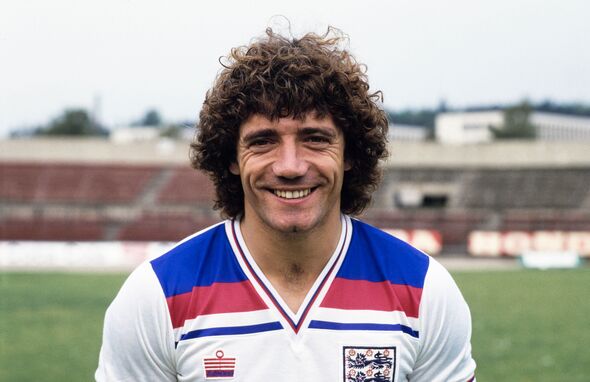
Kevin Keegan. The Self-Made Legend.
Kevin Keegan. The Self-Made Legend.

Rome, 25 May 1977. The Stadio Olimpico under floodlights, Liverpool in red, Borussia Mönchengladbach in white, and the European Cup waiting on a table by the touchline. It was Kevin Keegan's last game for the club he had helped carry from very good to genuinely great, and he did not score. He did something harder. For ninety minutes he pulled Berti Vogts, one of the finest defenders in the world, into places no defender wants to go, until Vogts finally brought him down in the penalty area and Phil Neal settled the matter from the spot. Liverpool were champions of Europe for the first time. Keegan shook hands, embraced his opponents, and walked away from English football at its absolute summit.
Most men would have stayed. The adulation was secure, the medals would have kept coming, the city adored him. Keegan chose instead to start again in a country where nobody owed him anything, in a language he did not yet speak. It was the most revealing decision of a revealing career, and it is where any honest account of the man must begin. Because the story of Kevin Keegan is not the story of a genius touched by the gods. It is something rarer and, for the rest of us, something far more useful. It is the story of a legend built entirely by hand.
Nothing was given
He was born in 1951 in a colliery village outside Doncaster, the son of a miner from County Durham. There was no academy pathway, no agent, no carefully managed development plan. There was a small boy who was told, over and over, that he was too small. Scouts passed. Trials came to nothing. When his chance finally arrived it came not from a great cathedral of the game but from Scunthorpe United, in the Fourth Division, where the pitches were mud from October to March and the crowds let you know precisely what they thought of you.
There is a romance to this now. There was none at the time. What Keegan took from those seasons was a habit that never left him for the rest of his life. He trained as if his talent were a rumour he had to disprove daily. Team-mates from every stage of his career tell the same story. First to arrive, last to leave, always working on the weakness rather than polishing the strength. He built his stamina running the terraces alone. He built his touch against brick walls. Nobody watched, and that was rather the point.
The gentleman footballer understands this instinctively. The substance of a man, like the wardrobe of a man, is not assembled in a day. It is built piece by piece, with patience, and the pieces that endure are always the ones that cost something.
Anfield, and the art of earning it

Bill Shankly signed him in the summer of 1971 for a fee so modest it now reads like a misprint. Keegan scored within minutes of his debut against Nottingham Forest, and within a season Anfield had a new heartbeat. What followed was one of the great careers in the history of the English game. Three league titles. An FA Cup. Two UEFA Cups. And finally, in Rome, the European Cup itself.
Yet the numbers were never really the point. The point was the manner of it. Keegan played as though every match were an audition. He pressed when pressing was not yet a philosophy, ran channels nobody had asked him to run, demanded the ball in impossible positions and then made the positions look reasonable. He dragged team-mates up to his own standard by sheer force of example. Shankly, a man who measured footballers almost exclusively by their appetite for work, found in Keegan the purest expression of everything he believed the game should be. The great manager gave him the stage. The player earned the right to stand on it every single week.
There is a quiet lesson in that partnership, and it travels well beyond football. Talent finds a stage. Character keeps it.
The courage to leave
In the summer of 1977, days after Rome, Keegan joined Hamburger SV for a British record fee. The move was widely questioned. England's finest player, leaving the newly crowned champions of Europe for the Bundesliga, voluntarily, at the height of his powers. It looked to many like vanity. It was in fact the opposite.
The first months were brutal. Some of his new team-mates resented the wages and the attention. The press was sceptical. Results wavered. A lesser man would have negotiated a quiet return home and blamed circumstance. Keegan responded the only way he knew. He learned German, properly, until he could give interviews in it. He moved his family into the community rather than above it. And he outworked every player at the club until scepticism turned first into respect and then into open devotion. The Germans, who do not hand out affection cheaply, nicknamed him Mighty Mouse.
By 1979 Hamburg were champions of Germany. Keegan was named European Footballer of the Year in 1978 and again in 1979, and he remains to this day the only Englishman ever to win the Ballon d'Or twice. Consider what that required. He gave up comfort, certainty and adoration in exchange for doubt, and turned the doubt into the finest individual honours of his life. The gentleman recognises the shape of that choice, because he faces smaller versions of it constantly. The right decision and the comfortable decision are rarely the same decision.
Style, worn lightly
Keegan was the first English footballer to fully understand that the game did not end at the touchline. The endorsements, the television appearances, the records, even the celebrated perm. It is easy to smile at the photographs now, and the perm has certainly dated. What sat underneath it has not.

He grasped, decades before the industry did, that presentation is a form of respect. Respect for the occasion, for the people watching, for oneself. He arrived everywhere prepared and immaculate. He gave his time generously to supporters and treated interviewers, ball boys and club staff with the same unhurried courtesy. He was professional about appearance before professionalism was fashionable in football, and he managed it without arrogance, which is the difficult part. Style that announces itself is merely fashion. Style worn lightly, in the service of respect rather than attention, is elegance. That distinction sits at the heart of everything we make and everything we admire.
One last climb
When he returned to England in 1980 he confounded expectations once again, choosing Southampton over the giants who wanted him. The reasoning was pure Keegan. He wanted to build something rather than inherit it. Two seasons later, into his thirties, he finished as the First Division's leading scorer and was voted Player of the Year by his fellow professionals, the judges whose opinion matters most and flatters least.

Then came the gesture that tells you almost everything. In 1982, with top clubs still calling, Keegan dropped down a division to join Newcastle United, the club of his father's people, a proud institution stranded far from where it belonged. He did not arrive as a museum piece collecting a final contract. He arrived as a labourer. For two seasons he carried the club on his back, mentored a generation of gifted young players coming up behind him, and in 1984 delivered the promotion the city had ached for. Then, the job done, he retired at once, resisting every invitation to decline slowly and profitably in front of a forgiving crowd. He left the pitch at St James' Park for the last time and was carried away into the night sky by helicopter, which sounds like theatre and was in fact the cleanest exit the game has ever seen. He gave a club back its self-respect and asked for nothing further. There are executives and craftsmen and fathers who spend a lifetime learning what Keegan understood at thirty-three. Finish the work properly, then leave the room while they still want you in it.
An honest man at Wembley
October 2000. The last match played beneath the old twin towers, England beaten by Germany in the London rain. Within an hour of the final whistle, Keegan had resigned as England manager. His explanation was startling in its simplicity. He felt he had come up short at the very highest level of the job, and he said so, plainly, without excuse, without negotiation, without an eye on his own legacy.
Careers in football, as in business, are usually defended to the last. Blame is distributed, narratives are managed, and the truth arrives years later in a memoir, if it arrives at all. Keegan looked at himself honestly in the worst hour of his professional life and acted on what he saw. It cost him the biggest job in English football. It preserved something worth considerably more. Integrity is not the absence of failure. It is the refusal to lie about it, to others or to yourself. Few moments in the modern game have demonstrated the difference so clearly.
The entertainer's creed

As a manager he built the most romantic side of the Premier League era. Newcastle United between 1992 and 1997 played football the way supporters dream it in childhood. Full backs who attacked, wingers who ran at men, a team sent out to score one more than the opposition and to do it beautifully. They were called The Entertainers, and the name was not ironic. The title race of 1996 slipped away from them in the spring, and when the pressure finally told, in front of the television cameras, what spilled out of Keegan was not calculation but raw feeling. He wanted it too much and hid it not at all.
They did not win the league. It scarcely matters now. Ask any neutral of that generation which team they loved, and the answer comes back in black and white. Keegan believed that how you play is inseparable from why you play, and that beauty is worth the risk of losing. Some defeats age better than victories. His have.
 He rarely wore the ten
It is true, and we may as well say it. Keegan spent most of his career in the number seven shirt. It changes nothing. The number ten, for us, was never arithmetic. It is a standard of conduct. Vision, generosity, responsibility, the willingness to take the ball when the game is at its hardest and to set the tempo for every man around you. It is the player who makes others better and carries the weight without complaint. By that measure Keegan was a ten in everything but the printing on his back. The shirt does not make the maestro. The conduct does.
The gentleman's lesson
Strip the story to its frame and this is what remains. A small man from a mining town who was told no, and who answered with work. A star who twice left comfort behind in search of a harder test. A public figure who told the truth about himself when a lie would have been cheaper and nobody would have checked. A manager who believed beauty was worth the risk, and paid for the belief, and never recanted it.
Legends, Keegan proves, are not born. They are built, morning by morning, choice by choice, in the hours when nobody is watching and the decisions when everybody is. The same is true of a reputation, a wardrobe, a marriage, a life. The materials matter. The stitching matters. Above all, the patience matters. Somewhere this evening a man will lay out a shirt for tomorrow, take a breath before a difficult conversation, and choose the harder, better option because that is simply who he has decided to be. Keegan would recognise him at once.
Join us.
Be a TENLEGEND™