
Sandro Mazzola (1942 to 2026): Worthy of Him | TENLEGEND
The son of Superga. The moustache of the Grande Inter. A man who asked only to be remembered as a good one. 1942 to 2026.

Vienna, 27 May 1964. In the tunnel of the Prater, a 21-year-old stands still. Across from him are Alfredo Di Stéfano and Ferenc Puskás. Real Madrid. Five times champions of Europe. The young man is not preparing. He is staring.
It is Luis Suárez who breaks the spell. Are we going out to play a final, he asks, or do you want to stand here watching Alfredo?
He goes out. He scores twice. Inter beat Real Madrid 3-1 and become champions of Europe for the first time.
Afterwards Puskás comes to find him. He gives the boy his shirt, and a sentence the boy will carry for the rest of his life. I played against your father. You are worthy of him.
Sandro Mazzola died on Saturday 19 September, aged 83. On Monday, Milan said goodbye to him at the Basilica of Sant'Ambrogio. To understand what was lost, you have to begin with that sentence in Vienna. Sandro Mazzola spent his whole life being measured against a man he barely had time to know.

The weight of a name
Valentino Mazzola was the captain of the Grande Torino, the side that ruled Italian football in the years around the war. There are still old men in Turin who will tell you he was the finest Italian footballer who ever lived. On 4 May 1949 the plane carrying the team home from a friendly in Lisbon struck the hill of Superga, above the city. Thirty-one people died. A team. A city's pride. A boy's father.
Sandro was six.
Think about what that inheritance means. Not money. Not a house. A surname that every man in Italian football recognised, and a legend that could never be argued with, because it had stopped at its peak. The dead do not have bad seasons. Every step the son took onto a pitch was a comparison. Every chance he missed was a verdict.
Most men would have run from that name. Some would have hidden inside it. Sandro Mazzola did neither. He did not wear the maroon of Torino. He made his name in the black and blue of Inter, in another city, on his own terms.

Nine to one
His first appearance in Serie A should have been a humiliation. It became something else.
Turin, 10 June 1961. Inter were sent to play Juventus in a match that had already been played once and abandoned after a pitch invasion. The authorities first awarded Inter the win, then ordered a replay. The club's president, Angelo Moratti, took it as an insult. In protest he sent the youth team.
Among the boys was an 18-year-old with school exams coming. His teammates wanted him in Turin. He asked his headmaster for permission, on the grounds that it might be the only Serie A match he would ever play. The headmaster said yes.
Juventus had just been crowned champions. Omar Sívori scored six. The final score was 9-1. Inter's only goal came from the penalty spot, and the boy who took it was Sandro Mazzola.
The story goes that Giampiero Boniperti, the Juventus captain, found him afterwards. He had known his father on the pitch. He told the boy he was worthy of him. Three years later, in Vienna, Puskás would say it again.
Sixty-five years on, when Inter announced his death, they shared the wish he had repeated often. He wanted to be remembered as a good man. As someone who keeps fighting even when winning is impossible. Like in that 9-1.
Consider the choice. A man with two European Cups, four league titles and a World Cup final to his name. And the match he asked us to remember was a defeat by eight goals, played by children in protest. That is not modesty for show. That is a man who understood what the game had taught him.

Il Baffo
Helenio Herrera was building something at Inter. A team that would become the Grande Inter, one of only two Italian sides ever granted that title. The other was his father's.
The names still carry weight. Suárez, the conductor. Facchetti, the full back who attacked. Burgnich. Corso and his left foot. Jair on the wing. A defence that gave nothing away and a counterattack that arrived like a closing door.
Herrera took the young centre forward and moved him into the space between the lines. It suited him. Mazzola was quick, tireless, inventive, and he knew where the goal was without needing to look. He did not have his father's grace, some said. He had something more useful to the team around him. He was everywhere, and he finished what he started.
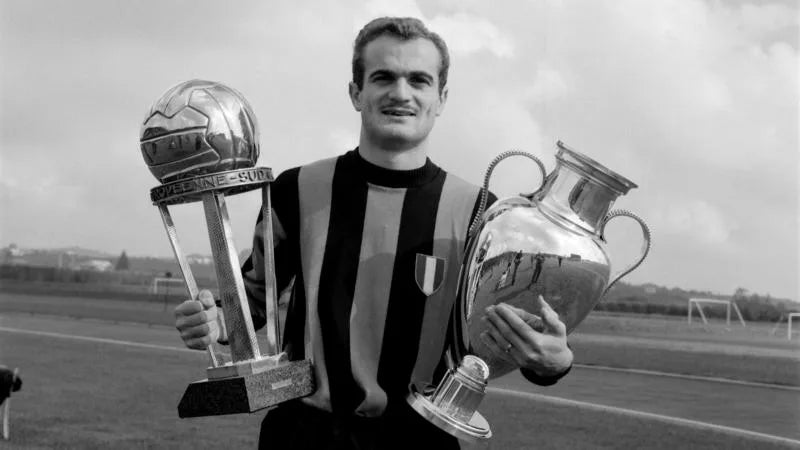
He also had the moustache. Italy called him Il Baffo. A slim young man with a dark moustache, running at defences in black and blue. It became the image of an era.
The titles came in a rush. The league in 1963. The European Cup in Vienna in 1964, where he finished the competition as joint top scorer with seven goals. The Intercontinental Cup against Independiente that autumn. Then 1965, perhaps the finest season of his life. Seventeen league goals, the most in Serie A. A second league title. A second European Cup, won against Benfica at San Siro. A second Intercontinental Cup. Another league title followed in 1966, and a fourth in 1971.
He knew the other side of the game too. In Lisbon in 1967, he scored a penalty after seven minutes of the European Cup final, and Inter lost 2-1 to Celtic. Great players are not defined by the nights they win. They are defined by how they walk off the pitch on the nights they lose.
In 1971 he finished second in the Ballon d'Or, behind Johan Cruyff. There is no shame in finishing behind Cruyff.
By the time he stopped, he had made 417 appearances in Serie A and scored 116 goals, and more than 560 appearances for the club across all competitions. Every one of them for Inter.
The relay
Across the city, at Milan, there was Gianni Rivera. The golden boy. Elegant, cerebral, adored. For more than a decade the two men divided Milan, and for one summer they divided Italy.
Mazzola won the European Championship with Italy in 1968, in a replayed final against Yugoslavia in Rome. Two years later, at the World Cup in Mexico, the coach Ferruccio Valcareggi faced a problem most coaches would envy. He had two of the finest attacking players in the world and did not believe they could play together.
His answer was the staffetta. The relay. Mazzola would play the first half. Rivera would play the second. It carried Italy to the semi-final against West Germany, a 4-3 epic that Italians still recite like poetry. It carried them to the final against Pelé's Brazil. Italy lost 4-1. Rivera came on for the last six minutes.
The country argued about it for decades. Mazzola himself said it was something that could only have happened in Italy. He finished with 70 caps and 22 goals, and played in three World Cups.
What matters is what came after. Rivalry at that level can curdle into something small. With these two it did not. Which brings us to his last day.
The last number ten
3 July 1977. The Coppa Italia final. Inter against Milan, the derby, at the end of a career that had begun with a penalty in a 9-1 defeat sixteen years earlier.
Mazzola walked out in a white shirt, with the captain's armband on his arm and the number 10 on his back.
At the centre of the pitch, he greeted the Milan captain. Gianni Rivera. His rival. The other half of the relay. Two men who had been set against each other by a nation, shaking hands in the middle of the city they had shared.
Milan won. The cup went to the Rossoneri. The applause went to Sandro.
He said goodbye with a line from Dante, from the third canto of the Inferno. Vuolsi così colà dove si puote ciò che si vuole, e più non dimandare. It is willed so, where what is willed can be done. Ask no more.
The number 10 has always meant something that goes beyond position. It is the player who carries the team's imagination. The one every boy in the street wants to be. Mazzola did not wear it through every season of his career. He wore it on the last day, as captain, in a derby, against the man he had been compared to for fifteen years. Some numbers are given. Some are earned.
The game remains
He did not leave. He never could.
He served Inter in the years that followed, as a director and later as sporting director. Then he went to Turin, to work as a director at Torino. His father's club. The boy who had refused to live inside the name returned to it, at last, as a man who had written his own.
For years he sat in the commentary box for RAI, explaining the game to a country that had watched him play it. The voice was calm. The judgement was fair. He had nothing left to prove, and it showed.
The game remains an essential part of our souls, even when we no longer play. Few men have lived that sentence as completely.

What he leaves us
Strip away the medals and three things remain.
The first is respect. He received it young, from Boniperti in a dressing room in Turin and from Puskás on a pitch in Vienna. Men who owed him nothing chose to honour him, and to honour his father through him. He spent the rest of his life returning that respect. To opponents. To rivals. To Rivera in the centre circle on his final day.
The second is resilience. Not the loud kind. Not the kind that makes speeches. The quiet kind that carries a dead father's name for seventy-seven years without once using it as an excuse or a shield.
The third is the lesson he chose for himself. Keep fighting even when winning is impossible. He could have asked to be remembered for Vienna. He asked to be remembered for Turin, and a boy taking a penalty in a match already lost.
We are gentlemen playing the game to win, always respecting our opponents. That is how we describe ourselves at TENLEGEND, and it is the most accurate description of Sandro Mazzola we know.
He inherited a legend. He crafted his own.
He was worthy of him. Ciao, Sandro.
Be a TENLEGEND™
www.tenlegend.com