
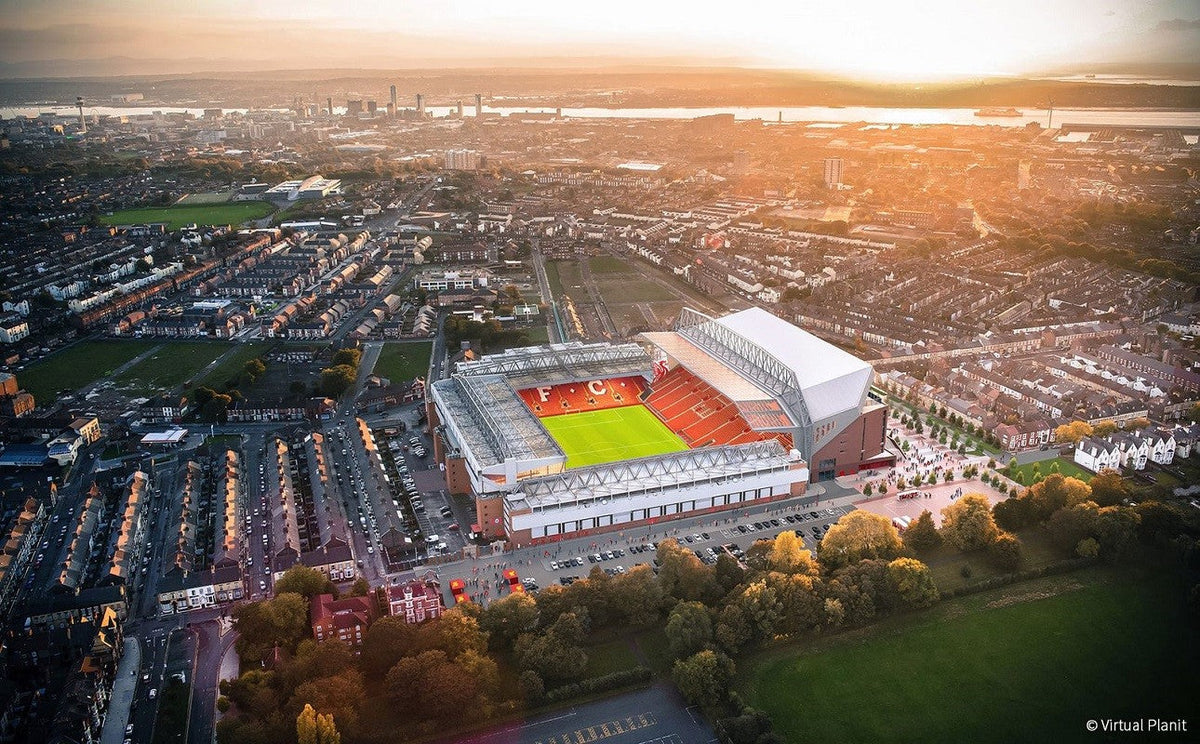
Anfield: The Soul of Liverpool, The Spirit of the Beautiful Game
There are stadiums that host matches, and then there are cathedrals of football, hallowed grounds where history, passion, and identity converge. For Liverpool, that sacred place is Anfield. More than bricks and steel, more than terraces and seats, Anfield is an experience. It is a cathedral, heartbreaks, triumphs, and eternal songs echoing through generations.
To understand Anfield is to understand not only Liverpool Football Club, but also football itself, the way it binds people to place, heritage, and each other.
Origins: When a Dispute Sparked a Legend
Anfield’s story begins long before Liverpool Football Club was born. The stadium was originally constructed in 1884 for Everton FC, who occupied it for eight years. The land belonged to John Houlding, a brewer and politician with strong ties to the local community. Yet what began as a fruitful partnership soured over rising rents, ownership quarrels, and disagreements about the club’s direction.

In 1892, Everton left Anfield for Goodison Park, a move that could have left the ground abandoned and forgotten. But Houlding was not one to let history pass him by. Instead, he formed a new club to occupy his stadium, Liverpool FC. Their first official match at Anfield saw them win 7–1 against Rotherham Town, a fitting prologue to a future steeped in glory. What began as a landlord’s solution turned into the birth of one of the world’s most iconic clubs.
Anfield grew quickly alongside its new tenants. In the early 20th century, the famous Spion Kop was constructed in 1906, named after a hill in South Africa where local soldiers had died in battle. It became the heartbeat of the stadium, a swaying, roaring sea of red scarves and banners. The Anfield Road Stand was added soon after in 1903, at first a simple timber-and-iron structure, modest in form but vital in presence.
Over the decades, the ground continued to evolve. Stands were expanded, roofs were added, and floodlights lit up the pitch for night games. In 1957, Anfield saw its first European match, a foreshadowing of the club’s continental dominance. In 1998, the Anfield Road Stand was redeveloped with an upper tier, bringing more supporters into the fold. And by 2024, following a modern redevelopment that lifted total capacity beyond 61,000, the stadium had become a blend of tradition and modern luxury—rail seating for safety, hospitality lounges for elegance, but still the same soul coursing through its veins.

Anfield is not just the home of Liverpool FC. It is the house that shaped their very identity, forged in dispute, reborn in resilience, and immortalized through victories and voices that refuse to fade.
A Global Stage: Cathedrals of the Game
We have written before of football’s grandest temples. In Buenos Aires, La Bombonera lives up to its name, the chocolate box that seems to hold the soul of Boca Juniors within its steep walls . There, passion takes a raw, unrestrained form. The stadium doesn’t just host matches...it shakes, trembles, roars. As we wrote in La Bombonera: Where Football Breathes, Roars, and Lives Forever, this ground is alive. It inhales the chants of its people, exhales their devotion, and pulsates with the heartbeat of Buenos Aires itself. We have personally never seen anything like it.
We have celebrated Wembley as the “Cathedral of Football,” where kings of the game are crowned and national pride is stitched into memory. We have wandered through the Maracanã in Rio, a place so drenched in history it feels like a living monument to Pelé, Garrincha, and the poetry of Brazilian football.
Yet even among these legends, Anfield stands apart. It does not overwhelm with sheer size like the Maracanã. It does not vibrate with the volcanic chaos of La Bombonera. Its magic is subtler, yet deeper. Anfield whispers as much as it roars, and those whispers are often louder than thunder.
A Gentleman’s Journey: Collecting Stadium Memories
Many of us have been fortunate to travel the world chasing football’s greatest stages. We have stood shoulder to shoulder with Boca fans in La Bombonera, where the terraces seem to lean forward, threatening to topple into the pitch with their collective roar. We have climbed the dizzying steps of the Camp Nou in Barcelona, marveled at the San Siro in Milan before its planned reinvention, and felt the sacred aura of Wembley on Cup Final days.
Each experience leaves a mark. Each ground etches a different shade of memory onto our souls. Yet ask any gentleman footballer for his bucket list, and Anfield always rises to the top. There is something irresistible about the pilgrimage. You do not just go to Anfield to watch a match—you go to feel something eternal.

The Song That Defines a People
No article on Anfield is complete without mention of its anthem: You’ll Never Walk Alone. It is more than a melody. It is the heartbeat of Liverpool. You do not know football....unless you understand what this song means.

The song began its journey far from the Kop. Written by Richard Rodgers and Oscar Hammerstein for the 1945 musical Carousel, it was a ballad of hope sung to comfort a young widow. In 1963, Gerry and the Pacemakers, a local Liverpool band, recorded their own version. It soared to number one on the UK charts, and like so many Merseyside hits of the era, it quickly found its way into the stands.

The Kop adopted it almost instinctively. Week after week, as the song topped the charts, the Anfield crowd sang it before kickoff. Even when its chart life faded, the tradition endured. It was no longer a hit on the radio—it was a hymn of the people.
Why did it resonate so deeply? Because it spoke to Liverpool’s very soul. A city defined by hardship and resilience, where docks had closed and communities had endured storms, found its reflection in lyrics about perseverance, hope, and solidarity. When tragedy struck—such as the Hillsborough disaster of 1989—the song became a collective prayer, a shield of comfort, and a vow of unity.
Today, when You’ll Never Walk Alone rises before kickoff, it is not a performance. It is a covenant.
A Story Within the Song
The first time you hear it live at Anfield, you will never forget it. The stadium lights dim slightly, the players line the tunnel, and the crowd begins—not with chaos, but with reverence. A murmur grows into a roar. The anthem climbs higher, rolling through the stands until it hits you in the chest.

Imagine walking onto the pitch wearing the red jersey, listening to You’ll Never Walk Alone as 50,000 voices surround you. Imagine the feeling in your gut. It is unreal. There is nothing bigger—except perhaps the birth of your children, or the rare, exalted moment of winning the World Cup. That is the scale of emotion Anfield commands.
Now imagine playing for the other team. You walk out in different colors, and the song is not yours, but it swallows you whole. Fifty thousand people, every syllable sung with conviction. In that instant, you either crumble, paralyzed by the weight of history and sound—or you rise, feeling like a superhero, ready to prove yourself on football’s ultimate stage. This is the competitor’s peak, the gentleman’s greatest test: do you have something inside, something greater than fear?
Then the final line of “You’ll Never Walk Alone”echoes, and just as suddenly as it began, the whistle blows. The match starts. But you are different. You have been baptized into something greater.

Legacy and Gentlemanly Values
Football, at its best, reflects values we hold dear: respect, dignity, resilience, camaraderie. Anfield has always been more than a fortress of intimidation—it has been a stage where those values play out. Opponents know they will be tested here, but they are also respected here.

From Bill Shankly’s belief that football was about bringing joy to working-class people, to today’s emphasis on community outreach, Anfield is a symbol of football’s greater purpose. It is not just about winning. It is about belonging, elevating, inspiring.
And this is where Anfield mirrors our own mission. At TENLEGEND®, we believe the beautiful game is more than what happens on the pitch. It is about living with passion, with style, with honor. It is about knowing that when you wear the number 10—or carry yourself like a gentleman—you represent something larger than yourself.
The Modern Cathedral of Liverpool

Today, as you step into the new Anfield Road Stand, with its sweeping views and elegant modernity, you are reminded that progress and tradition are not enemies. They are partners in legacy. The modern gentleman wears tailored elegance yet remains deeply connected to tradition. Anfield is the same.
From its timber beginnings to its steel and glass present, Anfield is not static. It grows, adapts, refines. Yet at its core, it is eternal, a place where the game is not only played but lived.

A Final Word
For Liverpool supporters, Anfield is home. For football fans everywhere, it is a shrine. From the chants that shake its foundations to the legends who have graced its turf, it is one of football’s greatest treasures.
To walk out and hear You’ll Never Walk Alone at Anfield is to understand why we fell in love with this game in the first place. It is authenticity, it is passion, it is elegance in raw form. And here is a plea to every television executive and every commentator: when You’ll Never Walk Alone begins, stop. No ads. No meaningless chatter. No interruptions. Sit back, don't talk, and let the world feel it. It is not background noise, it is a sacred moment. Like mass. Like prayer.
Anfield is not just Liverpool’s stadium. It is football’s reminder that history matters, tradition matters, and passion—always—matters most.
Be a TENLEGEND®.