
Forever Diego: The Imperfect Genius Who Made Football Beautiful
Forever Diego: The Imperfect Genius Who Made Football Beautiful
A TENLEGEND® Tribute

There are players who entertain. Then there are those who enchant. Diego Armando Maradona did both—often in the same heartbeat, sometimes in the same step. Yesterday, October 30th, the world paused once more to celebrate what would have been his 65th birthday. In Naples, a bronze statue of El Pibe de Oro—The Golden Boy—rode through crowded streets on the shoulders of devoted followers, greeted by flares that painted the sky orange and blue, chants that shook ancient cobblestones, and tears that fell without shame.
For millions across continents and generations, it was not simply a remembrance of a footballer, but a celebration of something that transcends leather and grass: the untamed spirit of football itself.
Because Diego was not perfect. He stumbled. He fell. He disappointed. He was human, raw, rebellious, and heartbreakingly fragile. But in that glorious imperfection lay his genius—the kind that cannot be coached, cannot be replicated, and can never be forgotten.

From Dust to Divinity
Born in Villa Fiorito, one of Buenos Aires' poorest neighborhoods where unpaved streets turned to mud when it rained and dreams were often the only currency that mattered, Diego rose from dust to divinity with nothing but a ball at his feet and fire in his belly. The corrugated metal roofs, the families of ten sharing two rooms, the smell of empanadas mixing with industrial smoke—this was his cathedral. This was where the gospel of Maradona was written.
From the very first time young Diego juggled an orange in those unforgiving streets because his family couldn't afford a proper ball, destiny took notice. Football, for him, was not a sport or a profession—it was oxygen. It was survival. It was the only language that made sense in a world determined to keep him small. It was poetry written in motion, with each dribble a verse, each feint a metaphor, and each goal a revelation that shouted to the heavens: I exist. I matter. I am here.
At eight years old, he was already performing at halftime shows for Argentinos Juniors, dazzling crowds with ball control that seemed to defy the laws of physics and childhood itself. By fifteen, he was playing professional football. By twenty-five, he was carrying the weight of a nation's dreams on his shoulders at the World Cup. The trajectory wasn't just remarkable—it was mythological.
The Gospel According to Mexico City

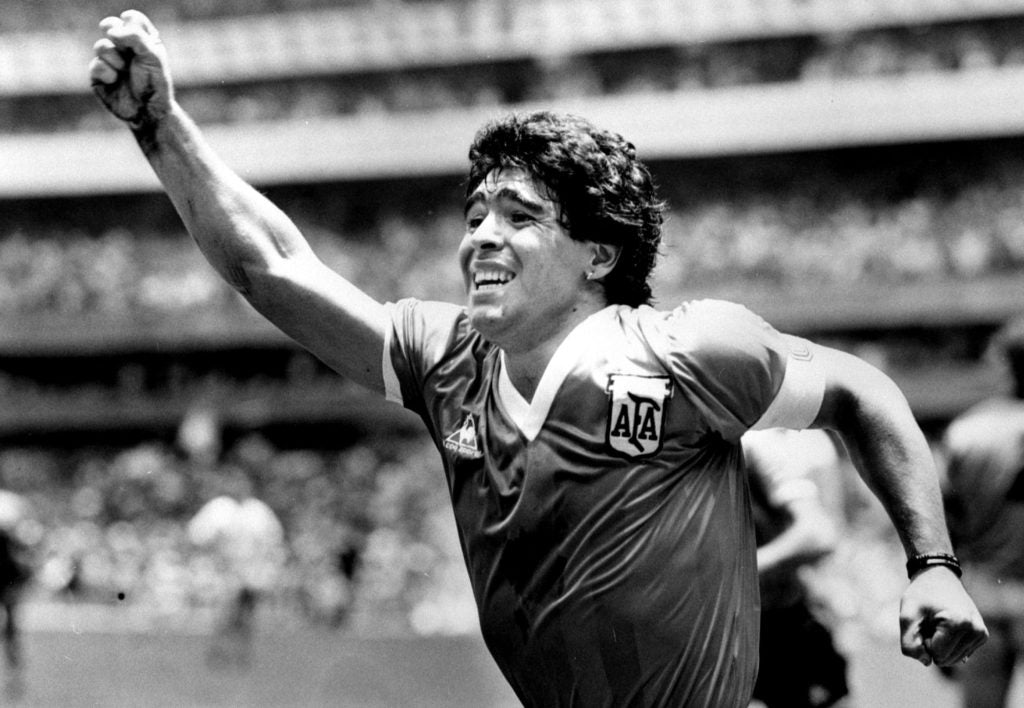
In 1986, at the Azteca in Mexico City, under a sun that beat down like judgment and before 114,000 witnesses, Maradona gave the world both sin and salvation in the span of five minutes. The "Hand of God" and "The Goal of the Century"—two sides of human nature, two pages in football's eternal gospel, two moments that would be debated in bars and living rooms for generations.
One deceitful, one divine. One that made England weep with rage, one that made them weep with awe. Together, they told the truth about greatness: it is not purity; it is not perfection; it is not the absence of shadow. Greatness is fire—beautiful, dangerous, and utterly consuming.

The first goal—that infamous punch, hidden in plain sight—was the street kid who learned that the world doesn't always play fair, so neither would he. It was controversial, cunning, unapologetic. It was the hand of a man who understood that survival sometimes requires bending the rules written by those who were never hungry.
The second goal—that goal, the one where he collected the ball at midfield and proceeded to dismantle the English defense like a master painter working through a canvas—was transcendence. Fifty-three seconds. Ten touches. Six defenders left grasping at ghosts. It wasn't just the greatest goal ever scored; it was football distilled to its purest essence, a moment where sport became art and art became religion.

To this day, commentator Victor Hugo Morales' call—his voice ascending from narration to prayer to ecstasy—gives listeners chills: "¡Barrilete cósmico! ¿De qué planeta viniste?" Cosmic kite, what planet are you from? The question was rhetorical. Everyone knew Diego belonged to all of us and to none of us, a gift we could never fully possess.
The Dance of the Streets
He played as if possessed by the streets that raised him, by every slight, every hunger, every moment he was told he was too short, too undisciplined, too much from the wrong side of the tracks. His low center of gravity—that compact, powerful frame that made him impossible to knock off the ball—became his signature. The hypnotic rhythm of his movement, the fearless joy that flashed in his eyes even when surrounded by defenders intent on destruction, the way he seemed to see the game three moves ahead while everyone else was still processing the present—Diego didn't just dance past opponents; he made them partners in a ballet they never auditioned for.
To watch him glide past defenders was to see freedom take form, unburdened by fear, convention, or the suffocating weight of tactical systems designed to suppress individuality. Coaches tried to cage him with instructions. Opponents tried to break him with violence—and they tried, inflicting over 500 fouls on him during that 1986 World Cup alone, leaving his ankles swollen and bruised like overripe fruit. Nothing worked.
He didn't just play the beautiful game. He was the beautiful game—its joy, its rebellion, its refusal to be tamed.

A God in the South
In Naples, a city that lived in the shadow of Milan and Turin, a city that had always felt second to the industrialized north—overlooked, underestimated, mocked for its accent and its poverty—Diego became more than a footballer. He became a god. Not the distant, marble kind, but the kind who lived among his people, who ate their food, who spoke their language of struggle and pride.

A city that had never won Italy's Scudetto found its reflection in this short, defiant Argentine who understood what it meant to be dismissed before you ever had a chance to prove yourself. When he arrived in 1984, 75,000 people packed the San Paolo Stadium just to watch him juggle a ball. They didn't come to see a player; they came to witness the arrival of their champion, their voice, their vindication.
Napoli's two Scudetti in 1987 and 1990 were not just football victories etched in record books. They were a social revolution. They were the South telling the North: We are here. We matter. We are champions. Maradona turned a humble club into an empire, yes, but more importantly, he gave the people of Naples something more powerful than trophies, more lasting than medals: dignity.
Even today, thirty-five years after his departure, murals of Diego cover the Spanish Quarter's walls like secular saints. His number 10 jersey hangs in windows like a flag. The stadium bears his name. In Naples, Maradona isn't history—he's eternal present tense.
The Price of Divinity
But like all myths forged in fire, Diego's light burned too bright, too fast, too intensely to last forever without consequence. His flaws were as public as his genius—the addiction that stalked him from triumph to triumph, the chaos that followed like a shadow, the exile from the game that both saved and destroyed him. Cocaine. Controversy. Suspensions. The 1994 World Cup cut short by a failed drug test, the image of him screaming into a camera in Boston—wild-eyed, unhinged, brilliant, broken—became as iconic as any goal.
Yet to those who truly loved him, those cracks only deepened the humanity behind the hero. The Japanese art of kintsugi teaches that broken pottery, when repaired with gold, becomes more valuable than it was when whole. Diego was kintsugi in human form. You cannot separate the artist from the man, the genius from the addict, the savior from the sinner. The same fire that consumed him also illuminated the world. The same passion that made him the greatest also threatened to destroy him.
He never pretended otherwise. He never asked for your forgiveness because he never apologized for being human.
The Last Authentic Hero
To speak of Maradona is to speak of emotion—raw, unfiltered, unapologetic, dangerous. He never hid behind the polished mask of modern celebrity, the carefully curated social media presence, the corporate-friendly soundbites that say everything and nothing. He cried on camera. He cursed at FIFA officials. He fought with journalists. He kissed the turf and prayed to his mother. He got a tattoo of Che Guevara and Fidel Castro because he believed in revolution. He lived football with every atom of his being, every contradiction, every extreme.
In an era of athletes who are brands first and humans second, Diego was defiantly, beautifully, messily real. And through him, we remembered why we fell in love with this game in the first place—not for the perfection, but for the passion. Not for the statistics, but for the stories. Not for the polish, but for the poetry.
The TENLEGEND® Philosophy
At TENLEGEND®, we believe football is a reflection of life—grace and struggle, triumph and redemption, beauty and pain existing simultaneously, inseparably. Diego embodied all of it without filter or apology. He reminded us that authenticity is more powerful than perfection, that beauty often hides in the flaws and the scars, and that passion, when pure and uncompromising, can transcend time, borders, and even death itself.
He showed us that legends aren't built on flawless resumes but on moments that take your breath away, on the courage to be yourself when the world demands you be something else, on the willingness to risk everything for the joy of the game.
This is what it means to Be a TENLEGEND®—to play with soul, to embrace your humanity, to leave everything on the pitch, to understand that greatness isn't about being perfect but about being unforgettable.

Eternal Number 10
Maradona's legacy is not measured in goals scored or trophies lifted, though there were plenty. It's not contained in highlight reels, though they've been watched billions of times. It lives in the boy juggling a ball in an alleyway in Manila, São Paulo, Lagos, or Los Angeles, dreaming of something greater than his circumstances. It lives in every player who dares to express themselves with audacity and soul, who chooses the beautiful dribble over the safe pass, who plays like every match might be their last. It lives in all of us who still believe football is art, emotion, and poetry—not just a game played by millionaires in sterile stadiums.
Diego once said, "If I die, I want to be born again and still be a footballer. And I want to be Diego Armando Maradona again."
The world would have it no other way. We need our flawed heroes, our beautiful disasters, our reminders that greatness doesn't come from playing it safe.
On what would have been his 65th birthday, as smoke from a thousand flares drifted over Naples and Buenos Aires, as his statue rode through streets that never forgot him, as grandparents told grandchildren stories that sounded like fiction but were all true—Diego reminded us one more time why he mattered.
Not because he was perfect.
But because he was perfectly, impossibly, unforgettably human.
Rest in play, Maestro.
The ball is still at your feet.
Heaven is on its feet applauding.
And somewhere, a kid with nothing but a dream and a ball is about to change the world.
Be a TENLEGEND®.