
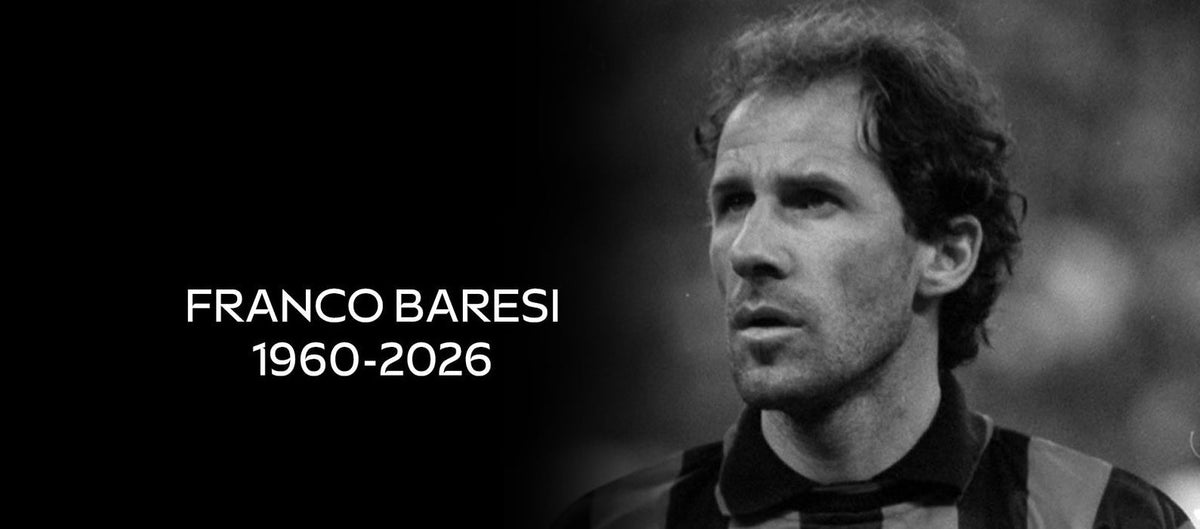
Franco Baresi: The Captain Who Made Defending an Art
There are footballers we admire and footballers we measure ourselves against. Franco Baresi belonged firmly to the second group.

He died on 31 July 2026, aged sixty six. AC Milan announced it in a few unadorned lines, saying that the whole history of the club was in tears. It was the right register. Baresi was never a man for ornament, and the grief that followed did not need any. Within hours the tributes had crossed every border the game has: from Milan to Naples, from Turin to Buenos Aires, from teammates to the opponents who spent two decades trying, and mostly failing, to get past him.
On Tuesday, in the Basilica of Sant'Ambrogio, red and black shirts filled the pews of a church that has stood in Milan since the fourth century. Ciao capitano, they said. It is difficult to imagine a more fitting setting for a man who understood that some things are built to last.
Pasadena, July 1994

If you want to understand Franco Baresi, begin at the end of a story he lost.
Twenty five days before the World Cup final in Pasadena, he had undergone surgery on his knee. The tournament, for him, was over. Everybody said so. Doctors, journalists, the arithmetic of recovery itself. He played the whole final anyway, all one hundred and twenty minutes of it, in California heat, against a Brazil attack of Romário and Bebeto, and he was arguably the finest player on the pitch.
Then he stepped up in the shootout and put the ball over the bar.
The photograph that survives is not of the miss. It is of what came after: Baresi doubled over on the turf, hands on his knees, entirely alone in a stadium of ninety thousand people. He did not blame the knee. He did not blame the heat, the surgeon, the referee, the schedule, or the teammates who missed alongside him. He carried it. In interviews years later he spoke about that penalty without flinching and without excuse, which is a rarer quality in sport than any amount of technique.
A gentleman is not a man who never fails. He is a man who fails in front of everyone and does not reach for somebody else to hold it.
The boy Inter did not want

He was born in Travagliato, a small town in the province of Brescia, in May 1960. His parents died young, and football arrived early as both refuge and vocation. He went for trials at Internazionale as a boy and was turned away. Too small, they said. Piscinin, the Milanese have it, the little one. They took his older brother Giuseppe instead.

So Franco crossed the city and knocked on the door of the other club, and Milan said yes, and he never left.
There is a lovely symmetry in what followed. Giuseppe captained Inter. Franco captained Milan. Through the late eighties, the image of the two brothers exchanging pennants in the centre circle before a derby became one of the defining pictures of Italian football: family and rivalry, standing a metre apart, shaking hands.
Loyalty, tested twice
The word loyalty is worn thin by overuse in football. Baresi gave it back its weight.
In 1980, Milan were relegated to Serie B after the Totonero match fixing scandal. Baresi was twenty, already an international prospect, and free to leave for any club in Europe. He stayed. He helped carry them back up. In 1982, on sporting merit this time, they went down again. He stayed again. He was made captain that same year, at twenty two, and he led a club in disgrace through the second division of its own country while the rest of his generation collected medals elsewhere.

It is worth pausing on that. The trophies came later, and they came in an avalanche. But the character was established in the years when there was nothing to win. Anyone can be devoted to a winning side. Baresi was devoted to a losing one, twice, on principle, and the devotion is the reason the winning eventually meant something.
The maestro at the back
When Arrigo Sacchi arrived in 1987, and Fabio Capello after him, Milan became the finest team on earth, and Baresi was the still point at the centre of it.
The numbers are almost absurd. Twenty years in one shirt. Seven hundred and nineteen appearances. Fifteen seasons as captain. Six Scudetti, three European Cups, two Intercontinental Cups, four Supercoppe, two European Super Cups. A 1988 title won conceding fourteen goals. A 1992 championship won without losing a match, inside a record run of fifty eight league games unbeaten. Eighty one caps for Italy, a World Cup winner's medal in 1982, third place in 1990, runner up in 1994. He is one of very few men to hold gold, silver and bronze from the tournament.

But the statistics are the least interesting thing about him, and he would have said so first.
Baresi stood five feet nine. He was not quick in a straight line and he was not imposing across the shoulders. What he had instead was a mind that ran three seconds ahead of the game. He intercepted rather than tackled. He stepped rather than lunged. He organised an offside line with the flick of a hand and made ten other men move as one body. He read a striker's intention in the striker's hips before the ball had left the passer's foot, and by the time the pass arrived he was standing where it was going.
Sacchi's Milan pressed higher up the pitch than any Italian side had dared, and the entire system rested on one assumption: that the man behind it would not be caught. He was not. On European nights the whole apparatus became something close to art. The 1989 semi final against Real Madrid at the San Siro, five goals to nil, is still spoken of in Milan the way people speak of a concert they attended once and have measured all music against since. Baresi did not score. He was, as ever, the reason it was possible.

In that same year he finished second in the voting for the Ballon d'Or. Defenders do not finish second in the Ballon d'Or. That anyone thought to place him there at all tells you how completely he had rewritten what a defender could be.
The Italians call it the libero, the free man. In Baresi's hands it became something close to conducting. He set the tempo of matches from seventy metres behind the opposition goal, which is a harder trick than doing it from thirty, and he did it for two decades alongside Tassotti, Costacurta and a teenage Paolo Maldini in what remains the finest defensive line the game has produced.
Maldini's tribute last week was the most affecting of them all. He wrote of feeling exactly as he did whenever, for whatever reason, the captain could not take the field beside them, and asked how they would manage without him. He described being protected as a boy, guided as a teenager, and inspired as a man, and said that Baresi taught by doing rather than by speaking. Few words, many deeds. That is the whole man in four syllables.
Why a number six belongs here
This is a brand built around the number ten, and Baresi wore six. Milan retired it for him in 1997, the first shirt in the club's history to be withdrawn, and it has hung untouched ever since.
We see no contradiction whatsoever.

The number ten has never really been a position for us. It is a disposition. It is the man on the pitch who sees the whole board, who decides the rhythm at which everyone else will play, who does the difficult thing with such economy that it looks like the easy thing. It is intelligence expressed as grace. By that definition Baresi was as pure a ten as the game has produced. He simply did his thinking facing the other way.
And he did it with a cleanliness that shames the modern game. He was among the least cynical great defenders in history, a man whose whole method was designed to make the foul unnecessary. He did not need to grab a shirt because he had already taken the space. He did not need to talk because he had already moved. Elegance, properly understood, is not decoration. It is the absence of anything wasted. Baresi defended the way a well cut jacket sits on the shoulder: nothing surplus, nothing straining, everything exactly where it should be.
A whole life in one place

He retired in 1997, at thirty seven, having played for the same club since he was a boy of fourteen. Most players at that point discover they have a career to invent. Baresi simply stayed where he was. He coached Milan's Primavera side, worked with the youth teams, took the title of honorary vice president, and spent the remainder of his life passing on to teenagers the thing that had been given to him at Milanello half a century earlier.
That is a form of achievement the game rarely celebrates properly. In an era when a career is a sequence of transfers and a badge is something you kiss until a better offer arrives, one man spent fifty years inside a single institution and made it better every year he was there. He belonged to Milan and Milan belonged to him, and neither of them ever felt the need to renegotiate the arrangement.
The last walk
In August 2025, Milan announced that their honorary vice president had undergone surgery to remove a pulmonary nodule and had begun treatment under a specialist. He faced it privately, as he had faced most things.
His final public appearance came in February of this year, at the opening ceremony of the Milano Cortina Winter Games. He carried the Olympic flame into the San Siro alongside Giuseppe Bergomi, the Inter captain who had spent his career on the opposite side of the derby. Two old rivals, walking together, in the stadium where both of them had spent their lives.
You could hardly design a better closing image. The opponent as a fellow gentleman, deserving of respect. The stadium as a cathedral. The fire carried carefully, and handed on.
What he leaves us
Football will remember Baresi for the trophies, and the trophies were extraordinary. We will remember him for the things that did not appear in any final score.
That he stayed when leaving was easy and forgivable. That he led at twenty two and never made the leading about himself. That he protected the young players around him and let them become greater than he was. That he played a World Cup final on a knee that had no business being there. That he missed, and owned it, and never once asked anybody to look elsewhere. That in twenty years at the very summit of a ruthless sport, nobody ever suggested he was anything other than a decent man.

This is what we mean when we talk about the gentleman footballer. Not the clothes, though he wore them beautifully. Not the honours, though he collected almost all of them. It is the quality of a man's conduct when the result is already decided and nobody is watching closely. Baresi's conduct was, from beginning to end, immaculate.
The shirt is retired. The example is not. It remains available to any of us, on any given day, in any room we walk into.
Ciao, capitano. Grazie di tutto.
Be a TENLEGEND™
www.tenlegend.com