
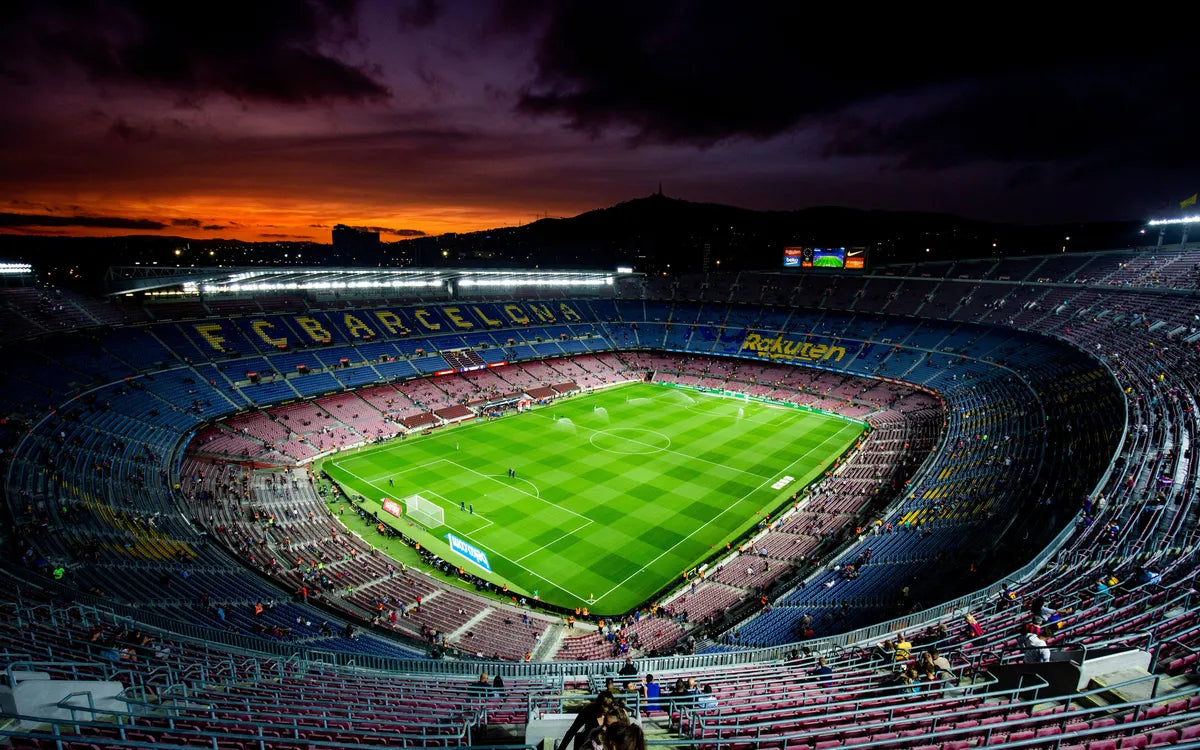
The Beautiful Game After Dark: Night Matches and Their Magic
There is a different game played under the lights.
Not a better game, necessarily. Not a worse one. But a fundamentally different expression of what football can be—sharper, more alive, more aware of its own power to move people in the dark.

When Floodlights Changed Everything
For decades, football existed in the daylight. Pitches were lit by the sun, by the natural rhythm of when men could gather, when shadows fell in ways that required genuine skill to navigate. Then came the floodlights. And football became something it had never been before: theatrical.
The first night match played under electric light was at Chelsea's Stamford Bridge in 1930. An experiment. A curiosity. The light was foreign, the experience disorienting. But something shifted. Football, when removed from daylight, became more vivid. The green of the pitch glowed. The white lines gleamed with definition. The players moved within a frame that the eye could absorb completely, rather than being distracted by the world beyond the boundary.
It was a kind of purification. Night football removed the casual observer. It created occasion. If you went to a match at night, you were not casually passing by. You were committed. You had chosen to be there, and that choice altered the experience fundamentally.
The Crowd Becomes Electricity
In daylight, a crowd can be loud but diffuse. The noise travels into open air, gets absorbed by the sky. At night, under the lights, with the walls of the stadium creating enclosure, the sound becomes something else entirely. It becomes tangible. Alive. A physical force that players can feel.
Watch a Champions League night match. The opening moments—when the crowd erupts, when the floodlights catch the shirt colors in a way that daylight cannot, when you can feel the electricity through the television screen—these moments are not football as ritual. They are football as religion.
The players feel it differently too. There is no ambient world to ground them. There is only the pitch, the ball, the crowd surrounding them in darkness. It narrows focus. It eliminates distraction. It forces the game to be about something essential: the moment between the player and the ball, and nothing else.

The European Nights
Anfield at night. The Bernabéu under lights. The San Siro when the crowd is singing. These are not merely venues. They are transformations of space into something that exists only in that configuration—that specific stadium, that specific night, that specific moment when thousands of voices find a single pitch.
Liverpool's European nights are legendary because something about Anfield—the Kop, the intimacy of the place, the way the stadium seems to crush inward—becomes supernatural under the lights. Players who seemed ordinary in daylight become heroic. Goals scored in those moments carry weight they would not carry in sunlight. The atmosphere rewrites the mathematics of the game itself.
This is not hyperbole. Study the records. European teams playing at home under lights have a measurable advantage that daylight matches do not provide. The crowd's presence is not merely emotional. It is tactical. It alters decision-making, reaction time, the confidence with which players move. Football under lights is psychology made physical.

Specific Moments in Night Mythology
Istanbul 2005. Liverpool against AC Milan in the Champions League final. Three-nil down at half-time. Most teams, facing that deficit in daylight, would accept defeat with dignity. But this match was being played at night, in front of a crowd that had paid for the privilege of witnessing their team's destruction. And something shifted.
The floodlights seemed to sharpen focus. The crowd, rather than deflating, became more unified. Liverpool's midfield—Gerrard, Hamann, Alonso—seemed to find spaces that had not existed. Milan's defense, which had been impregnable, began to falter. The match became not a football game but a ritual of resurrection. That night, under lights that seemed to rewrite the rules of the possible, Liverpool scored three goals in forty-five minutes and won on penalties. That match could not have happened in daylight. The night made it possible.
Nou Camp 1999. Manchester United in the Champions League final, two minutes remaining, the score locked at zero. Then night football created space for two goals in the final moment—moments that seemed impossible in the structure of the match, but which the night, with its heightened intensity and the crowd's amplified presence, somehow produced.
San Siro on a European night, when the Curva holds its breath before eruption. The Milan fans know that their stadium at night is a fortress. The visiting team knows this too. Before a ball is kicked, the psychology is established. San Siro in the evening is not merely a stadium. It is a statement about the price of entering it.

The Drama of Visibility and Shadow
Night football creates a different visual language. In daylight, every player is equally visible. Under floodlights, shadows emerge. A skillful player moving just beyond the edge of where the light falls can seem to vanish and reappear. The ball itself becomes more dramatic—you watch it more intensely because it is the brightest thing on the pitch.
The famous night matches in Champions League history often turn on moments where the light plays tricks. A goal scored in shadow that looks different on replay. A player's positioning obscured by the angle of the floodlights until the decisive moment. This is not accident. This is the nature of night football. It demands not just skill but presence of mind. The game becomes not just physical but perceptual.
Zinedine Zidane understood this. His performances in night matches, particularly in European competition, were often transcendent. Not because night football made him better, but because he understood how to move within the architecture that night created. He used the light and shadow. He positioned himself not just for the physics of the game, but for the way the crowd would see him, for the way the moment would be remembered.

The Memory That Lingers
Here is a peculiar truth: day football is often better played. The aesthetics are cleaner. The decision-making is clearer. Night football is frequently messier, more chaotic, more prone to both brilliance and error.
And yet it is night football that lives in memory.
Ask a man about the most important match he ever witnessed. He will likely describe it at night. The lights. The crowd. The sense that something was being contested that mattered beyond the game itself. This is because night football engages not just the mind but something deeper—the sense of occasion, of theatre, of being present for something that will not come again.
Barcelona's legendary Champions League nights. Real Madrid's European comebacks. Liverpool's miraculous Istanbuls. These are night moments. The daylight matches that were equally important are forgotten. But the night ones endure because they lived in a different register of human experience.
This is not sentimentality. It is neurology. The human brain encodes emotional experiences more deeply than routine ones. Night football creates emotional intensity through its context, its appearance, its whole presentation. A goal scored at midnight under lights seems to matter more than a goal scored at three in the afternoon, even if the mathematical result is identical. This is because night football is not about mathematics. It is about transcendence.

The Gentleman's Night Out
For the man who grew up playing, who remembers what it felt like to step onto a pitch, night matches offer something specific: they return him to that state of heightened awareness. Not as a player now, but as a witness. The focus required to play at night—the precision, the awareness, the sense that every movement is being scrutinized by thousands of eyes—this comes back when you watch.
A night match demands your full attention. You cannot half-watch. You cannot casually attend. The stadium will not permit it. The crowd will not permit it. You are either present or you are not, and if you are present, you understand something that daylight football cannot teach: that the game is not merely sport.
It is occasion. It is memory in formation. It is the moment when thousands of separate people become one voice, one breath, one prayer for something larger than themselves.
That is what night football does. It takes a game and turns it into something that will be remembered, debated, celebrated, and mourned for decades. It creates legend. And legend is what separates football from everything else.
We are drawn to these moments, the nights that defined players, that revealed character, that showed what a man is made of when the lights are on and the world is watching. The number 10 was always at his most brilliant on those nights. Composed. Purposeful. Utterly present.
That quality, that ability to rise when the occasion demands it, is not something that stays on the pitch. It is a way of moving through the world. And it is, at its heart, what every gentleman aspires to.
Be a TENLEGEND®.